DIMENSIONS OF RAINFALL ANOMALIES AND PLUVIAL DISASTER RISKS IN IMO MORPHO-CLIMATIC ZONES: AWARENESS AND ADAPTATION 97 22
DOI:
https://doi.org/10.83374/jesber.vol1no2.113Keywords:
climate adaptation, extreme rainfall, flood risk, gully erosion, Imo State, morpho-climatic zones, rainfall anomaliesAbstract
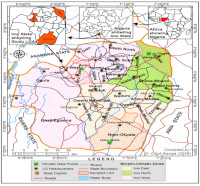
This study examined the spatial and temporal dimensions of annual rainfall anomalies, community awareness, and adaptation to pluvial disaster risks across the northern, eastern, and western morpho-climatic zones of Imo State, Nigeria. Annual rainfall data for 1923–2023 were obtained from the Climatic Research Unit time-series dataset using 0.5° × 0.5° cells for extraction. Primary data were collected from 442 respondents through structured questionnaires, and interviews, and analysed using descriptive statistics and linear trend models. The most severe negative anomaly occurred in eastern Imo in 1983 (−618.71 mm), whereas the highest positive anomaly occurred in northern Imo in 1954 (487.20 mm). Awareness of rainfall-related hazards was generally high, but perceived adaptation capacity was constrained by finance, government support, weather-monitoring capacity, and assets. Trend estimates indicated declining anomaly series across the three zones, although the western-zone trend was not statistically significant at the 5% level. The study concludes that high awareness has not translated into commensurate adaptive capacity. It recommends coordinated early warning, risk-sensitive land-use planning, drainage and erosion control, environmental education, and targeted household support. The study contributes zone-specific evidence for climate-risk governance in south-eastern Nigeria.Downloads
References
Alvala, R. C. S., Assis Dias, M. C., Saito, S., Stenmner, C., Franco, C., Amadeu, P., et al. (2019). Mapping characteristics of at-risk population. International Journal of Disaster Risk Reduction, 41, 101326. https://doi.org/10.1016/j.ijdrr.2019.101326
Amnuaylojaroen, T. & Parasin, N. (2024). Human health adaptation strategies to climate-induced extreme weather events: A systematic review. Earth, 5, 724 – 742. https://doi.org/10.3390/earth5040038
Aronica, G. T., Biondi, G., Brigandì, G., Cascone, E., Lanza, S., & Randazzo, G. (2012). Assessment and mapping of debris-flow risk in a small catchment in eastern Sicily through integrated numerical simulations and GIS. Phys. Chem. Earth 49, 52 – 63. https://doi.org/10.1016/j.pce.2012.04.002
Araújo, J.R., Ramos, A.M., Soares, P.M., Melo, R., Oliveira, S.C., & Trigo, R.M. (2022). Impact of extreme rainfall events on landslide activity in Portugal under climate change scenarios. Landslides 2, 19, 2279 – 2293. [CrossRef]
Ávila, A., Justino, F., Wilson, A., Bronwich, D., and Marcelo, A. (2016). Recent precipitation trends, flash floods and landslides in southern Brazil. Environ. Res. Lett. 11, 114029. https://doi.org/10.1088/1748-9326/11/11/114029
Bandeira, A.P.N., & Coutinho, R.Q. (2015). Critical rainfall parameters: proposed landslide warning system for the metropolitan region of Recife, PE, Brasil. Soils and Rocks 38, 27 – 48. http://www.soilsandrocks.com.br/soils-androcks/SR38-1_027-048.pdf
Cheru AN, Geleta TD, Tullu GM. (2025). Seasonal and annual rainfall variability over East Hararghe Zone, Oromia, Ethiopia. Academia Environmental Sciences and Sustainability, 2. https://doi.org/10.20935/AcadEnvSci7713
Crutzen, P.J. (2002). Geology of mankind. Nature, 415(6867), 23.
De Almeida, L. Q., Welle, T., and Birkmann, J. (2016). Disaster risk indicators in Brazil: a proposal based on the world risk index. International Journal of Disaster Risk Reduction, 17, 251–272. https://doi.org/10.1016/j.ijdrr.2016.04.007
Debortoli, N. S., Camarinha, P. I. M., Marengo, J. A., and Rodrigues, R. R. (2017). An index of Brazil’s vulnerability to expected increases in natural flash flooding and landslide disasters in the context of climate change. Natural Hazards 86, 557–582. https://doi.org/10.1007/s11069-016-2705-2
Di Giulio, G. M., Bedran-Martins, A. M. B., da Penha Vasconcellos, M., Ribeiro, W. C., and Lemos, M. C. (2018). Mainstreaming climate adaptation in the megacity of São Paulo, Brazil. Cities 72, 237–244. https://doi.org/10.1016/j.cities.2017.09.001
Ebi, K.L.; Semenza, J.C. Community-based adaptation to the health impacts of climate change. Am. J. Prev. Med. 2008, 35, 501–507. [CrossRef] [PubMed]
Jay, O., Capon, A., Berry, P., Broderick, C., de Dear, R, Havenith, G., Honda, Y., Kovats, R.S., Ma, W., Malik, A., et al. (2021). Reducing the health effects of hot weather and heat extremes: From personal cooling strategies to green cities. Lancet, 398, 709–724.
Mazzoglio, P., Ganora, D., & Claps, P. (2022). Long-term spatial and temporal rainfall trends over Italy. Environ. Sci. Proc 21, 2–8. https://doi.org/10.3390/environsciproc2022021028
Liu, X., Lyu, H.M. & Shen, S.L. (2025). Assessment of geo-disaster risk levels induced by extreme rainfall using integrated FCM-VIKOR approach. Georisk Assess. Manag. Risk Eng. Syst. Geohazards, 1 – 20. [CrossRef]
Liu, J., Yuan, X., Li, Y. & Li, X. (2025). Spatiotemporal Analysis of Extreme Precipitation in the Ili River Basin Based on CMIP6. Arid. Land Geogr., 48, 1329 – 1341. [CrossRef]
Li, Y., Zhang, Z., Gong, S., Liu, M. & Zhao, Y. (2020). Risk assessment of rainstorm disasters under different return periods: A case study of Bohai Rim, China. Ocean. Coast. Manag., 187, 105107. [CrossRef]
Li, X., Liu, J., Zhang, Z., Yuan, X., Li, Y., & Wang, Z. (2025). Geological disaster risk assessment under extreme precipitation conditions in the Ili River Basin. ISPRS International Journal Geo-Information, 14, 346. https://doi.org/10.3390/ijgi14090346
Malhi, Y., Gardner, T.A., Goldsmith, G.R., Silman, M.R. & Zelazowski, P. (2014). Tropical forests in the Anthropocene. Annual Review of Environment and Resources, 39, 11.1 – 11.35. http://doi.org/10.1146/annurev-environ-030713-155141
Marengo, J. A., Ambrizzi, T., Alves, L. M., Barreto, N. J. C., Simões Reboita, M., and Ramos, A. M. (2020). Changing trends in rainfall extremes in the metropolitan area of São Paulo: Causes and impacts. Frontier Climate, 2, 3. https://doi.org/10.3389/fclim.2020.00003
Marengo, J.A., Camarinha, P.I., Alves, L.M., Diniz, F. & Betts, R.A. (2021). Extreme rainfall and hydro-geo-meteorological disaster risk in 1.5, 2.0, and 4.0◦C Global Warming Scenarios: An analysis for Brazil. Frontier in Climate, 3, 610433. https://doi.org/10.3389/fclim.2021.610433
National Bureau for Statistics (2017). Annual Abstract for Statistics. Abuja.
National Population Commission (2009). National Population and Housing Census, Priority Table. Volume 11, Abuja.
Nobre, C. A., Young, A., Saldiva, P., and Marengo, J. A. (2011). Vulnerabilidades das Megacidades Brasileiras as Mudancas Climaticas: Regiao Metropolitana de São Paulo, eds C. A. Nobre and A. F. Young. São Paulo: Instituto Nacional de Pesquisas Espaciais and Universidade Estadual de Campinas. Universidade Estadual de Campinas Nucleo de Estudos de Populacao, Campinas. p. 188.
Sanchez, A. (2023). Local observations of climate change and adaptation responses: A case study in the mountain region of Burundi-Rwanda. Land, 12, 329. [CrossRef]
Segoni, S., Tofani, V., Lagomarsino, D. & Moretti, S. (2016). Landslide susceptibility of the Prato–Pistoia–Lucca provinces, Tuscany, Italy. J. Maps, 12, 401 – 406.
Sirisena J., Remedio A., Aronica G.T. & Bouwer L.M. (2026). Assessing future flood hazards with high-resolution climate model projections: a case study in northeastern Sicily, Italy. Frontier in Water 8, 1699802. https://doi.org/10.3389/frwa.2026.1699802
Steffen, W., Grinevald, J., Crutzen, P., & McNeill, J. (2011). The Anthropocene: conceptual and historical perspectives. Philosophical Transact ion of the Royal Society A 369(1938), 842 – 867.
Sujatha, E.R. & Sudharsan, J.S. (2024). Landslide susceptibility mapping methods—A review. In Landslide: Susceptibility, Risk Assessment and Sustainability: Application of Geostatistical and Geospatial Modeling; Springer Nature: Berlin/Heidelberg, Germany, 87 – 102.
Travassos, L., Torres, P. H. C., Di Giulio, G., Jacobi, P. R., De Freitas, E. D., Siqueira, I. S., et al. (2020). Why do extreme events still kill in the São Paulo Macro Metropolis Region? Chronicle of a death foretold in the global south. In. J. Urban Sustain. Dev. https://doi.org/10.1080/19463138.2020.1762197
Umo, I.S. (2025). Spatial patterns in soil chemistry and granulometry in the geomorphic hazards’ vulnerable land and the need for sustainable utilizations. Land Management and Utilization, 1(4), 1–18. https://doi.org/10.54963/lmu.v1i4.1601
Umo, I.S., Okoroafor, P.E.N., and Ukwe, I.G. (2021). Climate variability and the issues in flood disaster risk awareness in Nigerian communities. NIPES Journal of Science and Technology Research, 3(4), 271–282. https://doi.org/10.37933/nipes/3.4.2021.27
University of East Anglia Climatic Research Unit; Harris, I.C.; Jones, P.D.; Osborn, T. (2024): CRU TS4.08: Climatic Research Unit (CRU) Time-Series (TS) version 4.08 of high- resolution gridded data of month-by-month variation in climate (Jan. 1901- Dec. 2023). NERC EDS Centre for Environmental Data Analysis. https://catalogue.ceda.ac.uk/uuid/715abce1604a42f396f81db83aeb2a4b
Wang, Q. & Hou, J. (2023). Hazard assessment of rainstorm-geohazard disaster chain based on multiple scenarios. Natural Hazards, 118, 589 – 610. [CrossRef]
Young, A. F., Marengo, J. A., Coelho, J. O. M., Scofield, G. B., de Oliveira Silva, C. C., and Prieto, C. C. (2019). The role of nature-based solutions in disaster risk reduction: The decision maker’s perspectives on urban resilience in São Paulo state. International Journal Disaster Risk Reduction, 39, 101219. https://doi.org/10.1016/j.ijdrr.2019.101219
Zalasiewicz, J., Williams, M., Smith, A., Barry, T. L., Coe, A. L., Bown, P. R., Brenchley, P., Cantrill, D., Gale, A., Gibbard, P., Gregory, F. J., Hounslow, M., Kerr, A. C., Pearson, P., Knox, R., powell, J., Waters, C., Marshall, J., Oates, M., Rawson, P. & Stone, P. (2008). Are we now living in the Anthropocene? Geological Society of America Today, 18, 4 – 8.
Zalasiewicz, J., Williams, M., Steffen, W. & Crutzen, P. (2010). The New World of the Anthropocene. Environmental Science and Technology, 44, 2228 – 2231.
Downloads
Published
Issue
Section
License
Copyright (c) 2026 Journal of Enviromental Sciences and Built Environental Research

This work is licensed under a Creative Commons Attribution-NonCommercial-ShareAlike 4.0 International License.
All articles are published under Creative Commons Attribution 4.0 International License (CC BY 4.0). Users may share, adapt, and distribute the work provided appropriate credit is given to the authors and JESBER.