STATE-LEVEL SPATIAL PATTERN OF CAREGIVER-REPORTED ACUTE RESPIRATORY INFECTION SYMPTOMS AMONG CHILDREN UNDER FIVE IN NIGERIA: EVIDENCE FROM THE 2021 MICS 0 0
DOI:
https://doi.org/10.83374/jesber.vol1no2.68Keywords:
Caregiver-reported ARI symptoms, Spatial autocorrelation, Healthcare utilization, State-level poverty, Household crowding, Under-five mortality, NigeriaAbstract
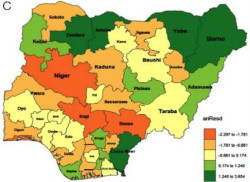
Acute respiratory infections (ARIs) remain a leading cause of under-five mortality in Nigeria, yet interventions often overlook localized spatial dynamics and healthcare barriers. This study examines geographic variations, socioeconomic risk factors, and healthcare-seeking behaviors associated with caregiver-reported childhood ARIs symptoms in Nigeria. Utilizing cross-sectional data from the 2021 Multiple Indicator Cluster Survey, caregiver-reported ARI symptoms spatial distribution was analyzed using Moran’s I techniques. An Ordinary Least Squares (OLS) regression model assessed the impact of structural vulnerabilities on state-level caregiver-reported ARI prevalence, while descriptive statistics evaluated healthcare utilization. A stark North-South divide was identified (Global Moran's I = 0.377, p < .001), with critical hotspots clustered in Katsina, Zamfara, and Yobe. The OLS regression explained 36.6% of state-level variance (F(2, 34) = 11.41, p < .001), isolating poverty (β = 0.025, p = .034) and household crowding (β = 1.667, p = .032) as key predictors whose inclusion absorbed all spatial autocorrelation. Formal healthcare utilization was critically low (39.4%). Care-seeking failure reached 36.3% among urban caregivers compared to 22.1% in rural areas due to indirect costs. Private providers and pharmacies outpaced public facilities (39.1% vs. 34.7%), while high wealth and maternal education significantly reduced non-seeking behavior. The northern ARI burden is driven by concentrated socioeconomic and infrastructural deprivation rather than geography alone. Low care-seeking rates reveal severe financial barriers and heavy reliance on informal private networks. Interventions must prioritize targeted funding for northern hotspots, enforce ventilation building codes, subsidize clean-cooking stoves, and integrate private vendors into formal health networks.Downloads
References
Addie, O., & Seun-Addie, F. (2025). Spatial analysis of cesarean section rates in Nigeria. SAGE Open, 15(3). doi.org
Adeoti, I. G., & Cavallaro, F. L. (2022). Determinants of care-seeking behaviour for fever, acute respiratory infection and diarrhoea among children under five in Nigeria. PLoS ONE, 17(9), e0273901. doi.org
Adesanya, O. A., & Chiao, C. (2017). Environmental risks associated with symptoms of acute respiratory infection among preschool children in North-Western and South-Southern Nigeria communities. International Journal of Environmental Research and Public Health, 14(11), 1396. https://doi.org/10.3390/ijerph14111396
Adesanya, O. A., Darboe, A., Mendez Rojas, B., & Chiao, C. (2017). Factors contributing to regional inequalities in acute respiratory infection symptoms among under-five children in Nigeria: A decomposition analysis. International Journal for Equity in Health, 16, 140. https://doi.org/10.1186/s12939-017-0626-7
Agbor, C. N., Etim, O. E., Arikpo, E. B., Apeh, C. A., Orji, E. I., Ugbaka, M. A., Odey, F. I., Atemgweye, G. I., Effiom, A., & Eneyo, V. B. (2026). Socio-economic impacts of conservation policies on women’s livelihoods in forest-dependent communities around Cross River National Park, Nigeria. African Journal of Hospitality, Tourism and Leisure, 15(2), 306–315. https://doi.org/10.46222/ajhtl.19770720.740
Amsalu, E. T., Akalu, T. Y., & Gelaye, K. A. (2019). Spatial distribution and determinants of acute respiratory infection among under-five children in Ethiopia: Ethiopian Demographic Health Survey 2016. PLoS ONE, 14(4), e0215572. https://doi.org/10.1371/journal.pone.0215572
Anselin, L. (1995). Local indicators of spatial association—LISA. Geographical Analysis, 27(2), 93–115. https://doi.org/10.1111/j.1538-4632.1995.tb00338.x
Bakare, A. A., King, C., Salako, J., Bakare, D., Uchendu, O. C., Burgess, R. A., Shittu, F., Iuliano, A., Isah, A., Ahmed, T., Ahmar, S., Valentine, P., Olowookere, T. F., McCollum, E. D., Colbourn, T., Falade, A. G., & Graham, H. R. (2023). Pneumonia knowledge and care seeking behavior for children under-five years in Jigawa, Northwest Nigeria: A cross-sectional study. Frontiers in Public Health, 11, 1198225. doi.org
Bivand, R. (2023). rgdal: Bindings for the "Geospatial" Data Abstraction Library (Version 1.6-7) [Computer software]. The Comprehensive R Archive Network. https://cran.r-project.org/web/packages/rgdal
Bivand, R., & Wong, D. W. S. (2018). Comparing implementations of global and local indicators of spatial association. TEST, 27(3), 716–748. https://doi.org/10.1007/s11749-018-0599-x
Chilot, D., Shitu, K., Gela, Y. Y., Getnet, M., & Wolde, O. (2022). Factors associated with health-seeking behaviour for symptomatic acute respiratory infection among children in East Africa: A cross-sectional study. BMC Pediatrics, 22, 662. doi.org
eHealth Africa, & GRID3. (2024). GRID3 NGA - Operational State Boundaries [Data set]. GRID3 Data Hub. https://data.grid3.org/datasets/GRID3::grid3-nga-operational-state-boundaries-/about
Eneyo, V. B. (2025). Essentials of tourism for beginners. University of Calabar Press.
Eneyo, V. B. (2026a). Heritage continuity and tourism readiness in Efik and Qua traditional festivals in Calabar South, Nigeria. Journal of Environmental Sciences and Built Environment Research, 1(2), 1–11. https://doi.org/10.83374/jesber.vol1no2.32
Eneyo, V. B. (2026b). Tourism activity, night-time exposure and spatially clustered crime in Calabar, Nigeria. Journal of Environmental Sciences and Built Environment Research, 1(2), 81–92. https://doi.org/10.83374/jesber.vol1no2.38
Gayawan, E., Orunmoluyi, O. S., & Adegboye, O. A. (2022). Geostatistical patterns of comorbidity of diarrhoea, acute respiratory infection, and stunting among under-five children in Nigeria. Mathematical Population Studies, 29(2), 58–72. doi.org
Islam, M., Islam, K., Dalal, K., & Hossain Hawlader, M. D. (2024). In-house environmental factors and childhood acute respiratory infections in under-five children: A hospital-based matched case-control study in Bangladesh. BMC Pediatrics, 24(1), 38. doi.org
Ketema, D. B., Dadi, A. F., Hassen, T. A., & Assemie, M. A. (2024). Individual- and community-level predictors of health-seeking behaviour for acute respiratory tract infections among children under five in 29 low- and middle-income countries: A multilevel analysis. Public Health, 237, 71–76. https://doi.org/10.1016/j.puhe.2024.08.028
National Bureau of Statistics & United Nations Children’s Fund. (2022). Multiple Indicator Cluster Survey 2021, survey findings report.
Oluwaseun, A., & Seun-Addie, F. K. (2025). Reducing acute respiratory infections in under-five children in Nigeria through the mirror of risk factors: A cross-sectional study. BMC Public Health, 25(1), 1948. https://doi.org/10.1186/s12889-025-23148-7
Orimadegun, A. E., & Myers, L. (2019). Sex-specific prevalence and trends in acute respiratory infection episodes among children less than 5 years in Nigeria. Nigerian Journal of Clinical Practice, 22(11), 1590–1599. doi.org
Osayomi, T., Ogbonnaiye, O. B., & Iyanda, A. E. (2020). Hotspots and drivers of acute respiratory infection among children in Nigeria. South African Journal of Child Health, 14(4), 224–232. https://doi.org/10.7196/SAJCH.2020.v14i4.1734
Rudan, I., Boschi-Pinto, C., Biloglav, Z., Mulholland, K., & Campbell, H. (2008). Epidemiology and etiology of childhood pneumonia. Bulletin of the World Health Organization, 86(5), 408–416. https://doi.org/10.2471/BLT.07.048769
Sani, J., Ahmed, A., Hassan, A. W., Wali, I. G., Usman, J., Umar, J. H., Khalid, U. S., & Ahmad, B. B. (2025). Understanding household smoke exposure risks (SER) in Nigeria: A regional analysis from the 2018 NDHS. BMC Public Health, 25(1), 1351. doi.org
Savitha, M. R., Nandeeshwara, S. B., Pradeep Kumar, M. J., ul-Haque, F., & Raju, C. K. (2007). Modifiable risk factors for acute lower respiratory tract infections. Indian Journal of Pediatrics, 74(5), 477–482. https://doi.org/10.1007/s12098-007-0081-3
Tennekes, M. (2018). tmap: Thematic maps in R. Journal of Statistical Software, 84(6), 1–39. doi.org
Tesema, G. A., Worku, M. G., Alamneh, T. S., & Alemu, T. G. (2022). Understanding the rural–urban disparity in acute respiratory infection symptoms among under-five children in Sub-Saharan Africa: A multivariate decomposition analysis. BMC Public Health, 22, 2013. https://doi.org/10.1186/s12889-022-14421-0
Tesfaye, S. H., Seboka, B. T., & Sisay, D. (2023). Spatial patterns and spatially varying factors associated with childhood acute respiratory infection: Data from Ethiopian Demographic and Health Surveys (2005, 2011, and 2016). BMC Infectious Diseases, 23, 293. doi.org
Titaley, C. R., Que, B. J., de Lima, F. V. I., & Pello, M. S. (2020). Healthcare-seeking behaviour of children with acute respiratory infection symptoms: Analysis of the 2012 and 2017 Indonesia Demographic and Health Surveys. Asia Pacific Journal of Public Health, 32(6–7), 310–319. doi.org
World Health Organization. (2022). Pneumonia in children. who.int
Downloads
Published
Issue
Section
License
Copyright (c) 2026 Journal of Enviromental Sciences and Built Environental Research

This work is licensed under a Creative Commons Attribution-NonCommercial-ShareAlike 4.0 International License.
All articles are published under Creative Commons Attribution 4.0 International License (CC BY 4.0). Users may share, adapt, and distribute the work provided appropriate credit is given to the authors and JESBER.