ASSESSMENT OF PUBLIC WATER SUPPLY AVAILABILITY AND UTILIZATION FOR SUSTAINABLE URBAN GROWTH AND MANAGEMENT IN CALABAR SOUTH LOCAL GOVERNMENT AREA, CROSS RIVER STATE, NIGERIA 94 15
DOI:
https://doi.org/10.83374/jesber.vol1no2.114Keywords:
Public Water Supply, Water Utilization, Sustainable Urban, Growth, Urban Management, Water Infrastructure, Calabar SouthAbstract
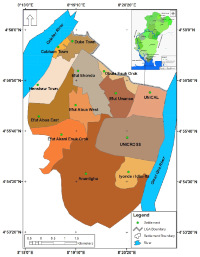
This study assesses public water availability and utilisation for sustainable urban growth and management in Calabar South Local Government Area. The study examines the extent of public water supply, patterns of utilization, challenges affecting access to potable water, and implications for sustainable urban development in the area. Calabar South Local Government Area was stratified into 13 ethnic residential settlements. Three hundred and ninety-six (396) questionnaires were systematically administered using 1.0 percent of the total number of houses per ethnic settlement. A descriptive survey research design was adopted using both primary and secondary data sources. Primary data were collected through questionnaires, interviews, and field observations, while secondary data were obtained from journals, textbooks, and government publications. Data collected were analyzed using descriptive statistical methods such as frequency tables and percentages. Findings indicate that irregular water supply, inadequate infrastructure, rapid population growth, and poor management practices significantly affected public water availability and utilization. The study concludes that efficient public water provision is essential for sustainable urban growth and recommends improved investment in water infrastructure, proper maintenance, and effective urban water management strategies.Downloads
References
Adebayo, O. S. & Galkaye, E. (2017). Public water supply in Lagos State, Nigeria: Review of importance and challenges, status and concerns and pragmatic solutions. Cogent Engineering. Vol 4, issue 1. Taylor & Francis Open access.
Adeniran, A., Daniell, K. A., & Pittock, J. (2021). Water Infrastructure Development in Nigeria: Trend, Size, and Purpose. https://www.mdpi.com/openaccess.
Aderibigbe, S. A., Awoyemi, A. O., & Osagbemi, G. K. (2008). Availability, adequacy and quality of water supply in Ilorin Metropolis, Nigeria. European Journal of Scientific Research, 23(4), 528-536
Akpabio, E. M. (2012). Water supply and sanitation services sector in Nigeria: The policy trend and practice constraints. ZEF Working Paper Series, No. 96. Center for Development Research
Ali, K. H. (2025). Critical Success Factors for Urban Water Projects in Nigeria: A comprehensive Analysis and Review. International Journal for Science for Global Sustainability (JSGS). Vol. 11(1)
Awuah, K. G. B., & Bijimi, C. K. (2024). Discovering the core stakeholders in the Nigerian urban water supply system. Sustainable Water Resources Management, 10(8). Doi:10.1007/s40899-023-00986-0
Ayoade, J. O. (1988). Tropical Hydrology and water Resources. London: Macmillan Publishers.
Edide, J. E. (2025). Assessing the impact of housing development on urban space dynamics in Calabar metropolis, Cross River State, Nigeria 1972-2022. Doctoral (PhD) Dissertation, University of Calabar, Calabar
Erifeta, K. E., Erifeta, G. O. O. (2025). On-Site Water Reuse Systems: A Sustainable Approach for Urban Water Management in Nigeria. International Journal of Environmental Sciences. Vol. 8(2): 12-32)
Fatunmibi, I. (2023). Sustainable Development Goal-Six (SDG-6) Water and Sanitation, Impact on Nigeria, Assessing the Intersection with Public Health and Globalization: A Systemic Literature Review.
Krejcie, R V., & Morgan, D. W. (1970). Determining sample size for research activities. Educational and Psychological Measurement, 30(3), 607-610
McDonald, R., Douglas, I., Revenga, C., Hale, R., Grimm, N., Growall, J., & Fekete, B. (2011). Global Urban Growth and the Geography of Water availability, Quality, and Delivery. AMBIO A Journal of Human Environment 40(5): 437-46
Naijadetails.com (2025) Facts About Cross River State Population
National Population Commission (NPC). (2006). Population distribution by sex, state, LGA and Senatorial district: 2006 census priority tables. Abuja, Nigeria: National Population Commission.
Ocheri, M. I., Odoma, L. A., & Umar, N. D. (2014). Groundwater quality in Nigeria urban areas: A review. Global Journal of Science Frontier Research, 14(2), 35-45.
Oyebode, O. J., Oyebode, F. A., Apeh, S.,Finbarrs-Ezema, B. C., Oladeji, S. O., Bayode, O. A., Aforolagbe-Balogun, O. T., Adeola, R. S., Iyanda, O. J., & Egbiki, S. (2026). Urban water management for public Health in Nigeria: Effective Governance and Sustainability Perspectives. Journal of Engineering and Engineering Technology. FUTA
Shuaibu, A., Hassan, A., & Abubakar, I. J. (2025). Towards integrating self-supply to enhance urban water governance in Yola North, Nigeria. Link.springer.com
United Nations (2021). Sustainable Development Goals Report. New York: United Nations
United Nations Development Programme (2020). Water Governance and Sustainable Urban Development Report. UNDP Publications.
United Nations. (2024). The Sustainable Development Goals report 2024. United Nations.
World Health Organization & United Nations Children’s Fund. (2025). Progress on household drinking water, sanitation and hygiene 2000–2024: Special focus on inequalities. WHO and UNICEF.
World Health Organization (2022). Guidelines for Drinking-water Quality. Geneva:WHO.
Yamane, T. (1967). Statistics: An Introductory Analysis (2nd ed.). New York: Harper and Row.
Downloads
Published
Issue
Section
License
Copyright (c) 2026 Journal of Enviromental Sciences and Built Environental Research

This work is licensed under a Creative Commons Attribution-NonCommercial-ShareAlike 4.0 International License.
All articles are published under Creative Commons Attribution 4.0 International License (CC BY 4.0). Users may share, adapt, and distribute the work provided appropriate credit is given to the authors and JESBER.